Adelaide, Australia
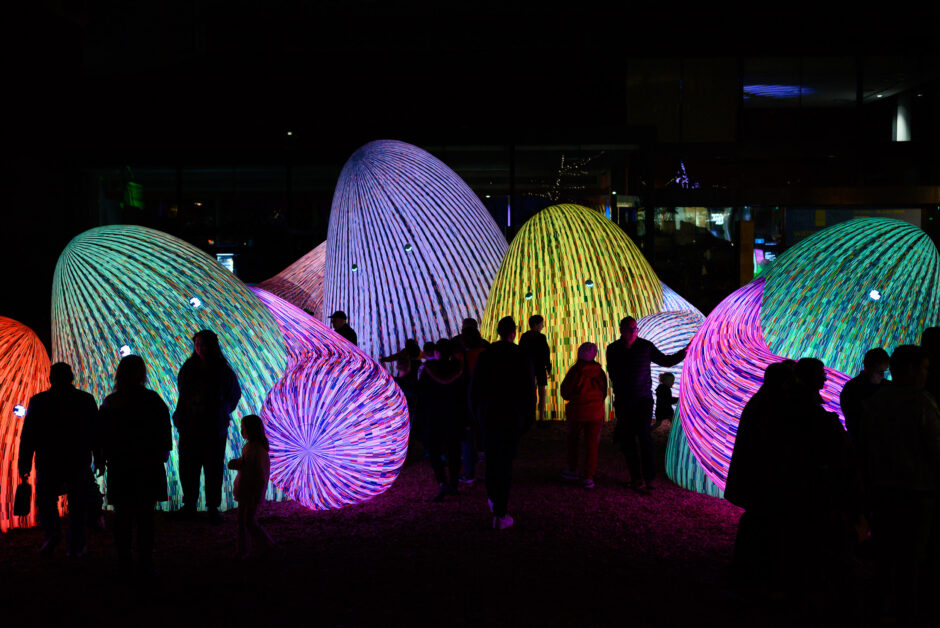
Whispering Mountains by ENESS, part of Illuminate Adelaide 2026.
“Man is in the ultimate degree of materiality and the beginning of spirituality; that is, he is at the end of imperfection and the beginning of perfection. He is at the furthermost degree of darkness and the beginning of the light. That is why the station of man is said to be the end of night and the beginning of day, meaning that he encompasses all the degrees of imperfection and that he potentially possesses all the degrees of perfection.” –‘Abdu’l-Bahá, Bahá’í Sacred Writings
Mary Cairncross Reserve, Brisbane, Australia

… it behoveth the people of truth that the signs of humility should shine upon their faces, that the light of sanctity should radiate from their countenances, that they should walk upon the earth as though they were in the presence of God and distinguish themselves in their deeds from all the dwellers of the earth. -Bahá’u’lláh Gems of Divine Mysteries
Rhode Island, USA

Strathcona Park, BC, Canada

O friend, the heart is the dwelling-place of eternal mysteries: Make it not the home of fleeting fancies. Waste not the treasure of thy precious life occupied with this swiftly passing world. Thou comest from the world of holiness: Bind not thine heart to the earth. Thou art a dweller in the court of reunion: Choose not the homeland of the dust. -Baha’u’llah -The Seven Valleys: The Valley of Wonderment
Otago, New Zealand

It is your duty to be exceedingly kind to every human being, and to wish him well; to work for the upliftment of society; to blow the breath of life into the dead; to act in accordance with the instructions of Bahá’u’lláh and walk His path—until ye change the world of man into the world of God. -Selections from the Writings of `Abdu’l-Bahá Pages 89-90
Shirakawa-go, Japan

Divine perfection is infinite, therefore the progress of the soul is also infinite. From the very birth of a human being the soul progresses, the intellect grows and knowledge increases. When the body dies the soul lives on. All the differing degrees of created physical beings are limited, but the soul is limitless! – `Abdu’l-Bahá, Paris Talks
Orimiston Gorge, Alice Springs, NT, Australia

Consider: according to the law of nature man liveth, moveth and hath his being on earth, yet his soul and mind interfere with the laws thereof, and, even as the bird he flieth in the air, saileth speedily upon the seas and as the fish soundeth the deep and discovereth the things therein. Verily this is a grievous defeat inflicted upon the laws of nature. So is the power of electrical energy: this unruly violent force that cleaveth mountains is yet imprisoned by man within a globe! This is manifestly interfering with the laws of nature. Likewise man discovereth those hidden secrets of nature that in conformity with the laws thereof must remain concealed, and transfereth them from the invisible plane to the visible. This, too, is interfering with the law of nature. In the same manner he discovereth the inherent properties of things that are the secrets of nature. Also he bringeth to light the past events that have been lost to memory, and foreseeth by his power of induction future happenings that are as yet unknown. Furthermore, communication and discovery are limited by the laws of nature to short distances, whereas man, through that inner power of his that discovereth the reality of all things, connecteth the East with the West. This, too, is interfering with the laws of nature. Similarly, according to the law of nature all shadows are fleeting, whereas man fixeth them upon the plate, and this, too, is interference with a law of nature. Ponder and reflect: all sciences, arts, crafts, inventions and discoveries, have been once the secrets of nature and in conformity with the laws thereof must remain hidden; yet man through his discovering power interfereth with the laws of nature and transfereth these hidden secrets from the invisible to the visible plane. This again is interfering with the laws of nature. -‘Abdu’l-Bahá, Bahá’í World Faith, p. 338
Maen Penddu, Wales

It should also be borne in mind that, great as is the power manifested by this Revelation and however vast the range of the Dispensation its Author has inaugurated, it emphatically repudiates the claim to be regarded as the final revelation of God’s will and purpose for mankind. To hold such a conception of its character and functions would be tantamount to a betrayal of its cause and a denial of its truth. It must necessarily conflict with the fundamental principle which constitutes the bedrock of Bahá’í belief, the principle that religious truth is not absolute but relative, that Divine Revelation is orderly, continuous and progressive and not spasmodic or final. Indeed, the categorical rejection by the followers of the Faith of Bahá’u’lláh of the claim to finality which any religious system inaugurated by the Prophets of the past may advance is as clear and emphatic as their own refusal to claim that same finality for the Revelation with which they stand identified.
-Shoghi Effendi, The World Order of Bahá’u’lláh
Las Vegas, Nevada, USA

The purpose of God in creating man hath been, and will ever be, to enable him to know his Creator and to attain His Presence…Whoso hath recognized the Dayspring of Divine guidance and entered His holy court hath drawn nigh unto God and attained His Presence, a Presence which is the real Paradise, and of which the loftiest mansions of heaven are but a symbol. -Bahá’u’lláh, Gleanings from the Writings of Bahá’u’lláh
St Paul, MN, USA

O ye young Bahá’í children, ye seekers after true understanding and knowledge! A human being is distinguished from an animal in a number of ways. First of all, he is made in the image of God, in the likeness of the Supernal Light, even as the Torah saith, “Let us make man in our image, after our likeness.”1 This divine image betokeneth all the qualities of perfection whose lights, emanating from the Sun of Truth, illumine the realities of men. And among the greatest of these attributes of perfection are wisdom and knowledge. Ye must therefore put forth a mighty effort, striving by night and day and resting not for a moment, to acquire an abundant share of all the sciences and arts, that the Divine Image, which shineth out from the Sun of Truth, may illumine the mirror of the hearts of men. -Selections from the Writings of ‘Abdu’l‑Bahá
Brilliant!